

Bunya Mountains Fungi
Welcome to the exciting world of FUNGI-FINDING!
Our brochure starts you on your fungi-finding way at the Bunya Mountains.
BEST TIME TO SEARCH: Any time of year; best finds occur during/after prolonged periods of rain or mist.
WHAT YOU NEED:
-
The brochure
-
Open eyes
-
Look carefully at ground level soil, leaf litter, tree trunks [upright and fallen]
-
Look for sudden changes of colour or odour - a likely fungal clue!

Sea Anemone Fungus
Our community brochure
Welcome to the exciting world of FUNGI-FINDING! Our brochure starts you on your fungi-finding way at the Bunya Mountains.
BEST TIME TO SEARCH:
Any time of year; best finds occur during/after prolonged periods of rain or mist.
WHAT YOU NEED:
• The brochure
• Open eyes
• Look carefully at ground level soil, leaf litter, tree trunks [upright and fallen]
• Look for sudden changes of colour or odour - a likely fungal clue!
DO NOT TOUCH OR EAT ANY OF YOUR FUNGI FINDS!
Acknowledgments
BCMAI would especially like to acknowledge the authors of "A Snapshot of Bunya Mountains Fungi", KEN CHAPMAN & MARY MAHONEY. They have provided advice and help along the way and given us access to their written and photographic material. Thank you so much, Mary and Ken.
Thank you also to Meg Noack for dedicated commitment to the collation of the brochure
Initial Advice: Dr. Sapphire McMullan-Fisher
Individual photographs: Anna Noack; Lynne Lipp; Meg Noack
Funding Acknowledgement: South Burnett Regional Council
Additional Resources
A good fungi-finder can be any age. A great fungi-finder always wants to know more.
WEBSITES:
iNaturalist: Download the app that will expand your knowledge enormously. It keeps you up to date with fungi names and what kinds of images are required if you want to share your images:
https://fungimap.org.au/record-map/
https://inaturalist.ala.org.au/projects/fungimap-australia
https://www.inaturalist.org/projects/australian-fungi-of-the-tropics-subtropics
Queensland Mycological Society: https://qldfungi.org.au
BOOKS:
A SNAPSHOT OF BUNYA MOUNTAINS FUNGI [2020] by Ken Chapman & Mary Mahoney
AUSTRALIAN SUBTROPICAL FUNGI [Revised Ed] [2023] by Sapphire McMullan-Fisher, Patrick Leonard & Frances Guard.
A FIELD GUIDE TO THE FUNGI OF AUSTRALIA [2022) by Dr. Tony Young. Illustrations by Kay Smith
OTHER BROCHURES:
"Fungi of Southeast Queensland"; "Mushrooms of Southeast Queensland"
See Fungimap online
An initiative of the Bunya Mts Community Assoc Inc (BMCAI) with Sponsorship Grant Funding gratefully received from the South Burnett Regional Councils Community Grants Program.
Introduced Fungi
REMEMBER - not all fungi are native. As with other introduced species, introduced fungi can cause problems
-
ORANGE PORE FUNGI [native of Madagascar]
-
PHYTOPTHORA A microscopic fungus from Africa that is killing Bunya pines [Araucaria bidwillii]
WHAT CAN I DO?
Do not walk where wild pigs have dug in the soil. ALWAYS use the foot-wash facilities on the walks. Keep the soles of shoes free of mud.
The Fungi
FAMILY GROUPS OF FUNGI:
Inside the brochure we have the most common fungi families found on the Bunya Mountains. Eleven of these families have been chosen for you to find. They are: Agarics, Stinkhorns, Puffballs, Polypores, Leathers, Cup & Disc Fungi, Toothed/Icicle Fungi, Corals, Slime, Jellies, Boletes.
FUNGI NAMES:
The brochure contains morphogroups, followed by scientific names and common names. It's a bit like your family name followed by your first name while the fungi's common name is your nick-name.
ABOUT LICHEN:
At the Bunyas, you will also see plenty of lichen. It can look like a plant but it isn't a plant. It can have different shapes - some have little branches, others have a leafy look whilst some look like spilt liquid that dried.
Agarics
Capped fungi
• Radiating gills
underneath
• Often have stems
• Include many we call 'mushrooms'

Coprinellus micaceus or truncorum
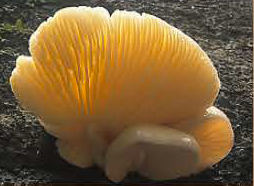
Pleurotus sp. [djamor var djamor possibly]

Macrolepiota sp. [possibly dolichaula]

Leucocoprinus birnbaumii Flowerpot Parasol

Leratiomyces ceres Redlead Roundhead

Hymenopelis sp. or Oudemansiella sp. [gigaspora possibly]

Coprinellus disseminatus Fairy Bonnets; Ink Caps

Cruentomycena viscidocruenta Ruby Bonnet
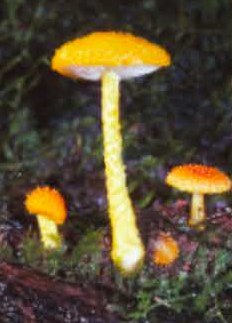
Cryptorama aspratum Gold Tufts

Lentinula lateritia Australian Shitake

Mycena leaiana var australis Orange-gilled Bonnet

Marasmius haematocephalus
Stinkhorns
• Emerge from an egglike structure
• A variety of shapese merge
• Spores smell foul; often attract flies and other
insects

Phallus multicolor Yellow Netted Stinkhorn

Phallus rubicundus Devil's Stinkhorn

Ileodictyon gracile

Ileodictyon gracile
Puffballs
-
A firm sac encloses spores
-
Spores spreadwhen sac opens

Lycoperdon sp. [possibly perlatum]

Calvatia lilacina Stages of decay

Calvatia lilacina (decaying)

Calvatia lilacina (decaying)
Polypores
-
Must have pores [NOT GILLS]
-
Pores [small holes] are underneath

Southern Bracket Ganoderma australe

Laetiporus sp. [sulphureus possibly] Sulphur Shelf

Amauroderma rude

Turkey Tails; Rainbow Fungus Trametes versicolor

Fuscoporia sp. [wahlbergii possibly]

Trametes sp.
Heading 2
Leathers
-
Have a thin structure [textured like leather]
-
Mostly found on wood
-
Smooth underneath
-
No gills and no pores on underside

Stereum versicolor Golden Curtain Crust

Cymatoderma elegans var lamellatum Leathery Goblet; Wineglass Fungus
Cup and Disc Fungi
-
Shaped as a bowl or cup
-
Spores form on inside surface

Discomycete [bisporella sp. possibly] Yellow Fairy Cups; Lemon Disco; Lemon Drops
Toothed or Icicle Fungi
Look like icicles
Corals
• Branching in a coral shape
Slime
-
Start as a dense, wet mass of small, egg shapes
-
May change colour and appearance
Jellies
-
Like jelly; a rubbery texture
-
Various shapes
-
Spores formed on the inside

Hericium sp.

Artomyces sp.

Artomyces austropiperatus Crowned or Peppery Coral
Heading 2

Fu/igo septica Dog's Vomit

Stemonitis sp. [axifera possibly]

Stemonitis sp. [splendens possibly]

Lycoga/a epidendrum Wolfs Milk

Auricu/aria cornea

Tremella mesenterica
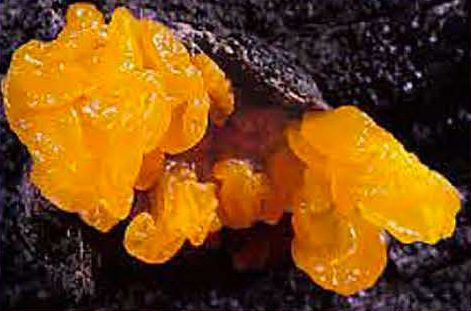
Heterobasidiomycetes sp.

Auricularia aff fifibrillifera [previously A. auricula-judae]
Boletes
-
Similar appearance to a mushroom-shaped Agaric
-
Most have pores, not gills, under the cap
-
Appear fleshy

Botetus sp.
Lichen
-
LICHENS are part fungi, algae and/or cyanobacteria.
-
The most common at the Bunya Mts. is Usnea rubicunda - Old Man's Beard with tiny branches and Heterodermia sp. - leafy shaped

Usnea rubicunda Old Man's Beard

Heterodermia sp.
FANTASTIC & WEIRD FACTS ABOUT FUNGI
AMAZING FUNGI FACT 1: Nature's Nightlight
The Ghost Fungus, Omphalotus nidiformis, is an Agaric and glows in the dark because of a chemical reaction creating bioluminescent light. It is a white rot fungus that breaks down wood. This decay helps the ecosystem by releasing nutrients that otherwise would stay locked away in the timber.
AMAZING FUNGI FACT 2: There are fungi that can turn insects into zombies.
They use insect bodies to grow. The insect probably eats the fungal spores. The spores grow and take over the insect's body. They are parasites. Ill Cordyceps hawkesii Drechmeria gunnii
AMAZING FUNGI FACT 3: Fungi use smell to attract insects.
Their group name, 'stinkhorns', is because they STINK!! A smelly, gooey spore mass oozes out of them. They smell like rotting flesh. The smell attracts insects that carry the spores away.
AMAZING FUNGI FACT 4: Fungi sends messages around the rainforest underneath your feet.
There is a maze of underground highways of interconnecting fungal threads so trees can communicate with one another. The fungi we see are visible signs of the highways beneath our feet!


